
Our team of experts offers regular updates on FPE and life safety best practices, code modifications and more.
December 8, 2025

In most building projects, fire protection begins and ends with prescriptive code. These standardized rules guide nearly every design decision and remain the industry default. But sometimes, a unique challenge — whether an architectural feature, an unforeseen condition, or an unexpected cost — forces the question: is there another way to achieve the same level of safety?
That’s where performance-based design comes in to supplement prescriptive code. When one or two code requirements can’t be met through traditional means, performance-based analysis provides a path to demonstrate equivalent or superior life safety through engineering and modeling.
Both methods are rooted in keeping people safe and minimizing property loss during a fire. However, they differ significantly in how design requirements are determined.
By understanding the role, strengths, and limitations of both approaches, you can better determine when to rely on prescriptive code and when to incorporate performance-based methods into your fire protection strategy.
Prescriptive code is a set of standardized, rule-based requirements that dictate exactly how fire and life safety systems should be designed, installed, and maintained. Generally, your building design is considered compliant if you adhere to the code.
Prescriptive codes are widely used in the fire protection industry. Authorities Having Jurisdiction (AHJs) rely on them because they’re straightforward to review and enforce. Codes such as the International Building Code (IBC) tell you when and where certain building features are required, such as when smoke control, fire alarm, and fire sprinkler systems must be provided. Whereas standards such as the many developed by the National Fire Protection Association (NFPA) provide specific guidelines on details for the design and installation of the various systems.
Prescriptive codes remain the default approach in fire protection because they offer a standardized path to compliance.
Prescriptive codes are written in a way that tells you exactly what to do. For fire protection engineers, architects, and contractors, this can save a significant amount of time. Rather than debating design options or running complex simulations, teams can refer to the code, check the box, and move on. This is especially valuable for smaller or conventional projects where time and budget constraints on the design side make efficiency critical.
Prescriptive fire protection codes and standards work hand in hand to define both the “what” and the “how” of life safety design. Codes establish where specific fire protection systems are required, specifying when a building must include sprinklers, smoke control systems, or fire alarm systems. Standards then provide the technical details on how those systems must be designed and installed.
Together, these documents outline the complete set of requirements, from system applicability to the fine-grained details of implementation. Standards define specifics, such as sprinkler spacing, allowable materials, hydraulic calculations, and installation methods, while codes dictate when and where those systems must be provided.
This relationship between codes and standards gives designers, contractors, and code officials a clear and consistent framework to follow, ensuring predictable safety outcomes and simplifying the path to compliance.
Because prescriptive codes are standardized and familiar to most code officials, plans that follow them tend to move through plan review and permitting more quickly. AHJs can check for compliance against a known checklist, making the approval process smoother and more predictable. For project teams, that generally means fewer back-and-forth revisions and a quicker path to construction.
While prescriptive codes provide structure and simplicity, they aren’t always the perfect solution, especially when applied to complex or unconventional buildings.
Prescriptive codes work well for standard buildings, but they can feel limiting when applied to structures with unique design features, unusual uses, or preexisting conditions. For instance, a building undergoing a change in occupancy may face limitations for building height and number of stories based on construction type.
When working on a facility such as a stadium, airport terminal, data center, or historic landmark, a prescriptive approach can become a rigid and sometimes unrealistic fit. These environments often introduce fire risks or architectural constraints that fall outside the typical scenarios envisioned by the code writers. The same is true for emerging technologies, where codes may be underdeveloped or not exist at all.
In such cases, the prescriptive path may require overly conservative or costly approaches that don’t necessarily improve safety. This is where performance-based design offers a valuable alternative, allowing engineers to craft tailored solutions based on actual risk and fire behavior modeling.
While prescriptive codes offer a clear checklist of requirements, they often fail to accommodate the complexity and creativity of modern building designs. Performance-based design allows engineers to develop customized fire protection strategies based on actual fire scenarios, risk analysis, and measurable performance objectives, rather than fixed code rules.
Performance-based design, sometimes referred to as alternative means and methods or variance in building code language, evaluates whether a design can achieve an equivalent or superior level of life safety and property protection compared to what the prescriptive code requires.
Through a performance-based approach, the effectiveness of various design options is evaluated by providing a series of fire and egress modeling simulations. Each simulation considers a specific design fire scenario. Each design fire scenario postulates fire specifics (heat release rate, growth rate, location, etc.), occupant specifics (number of occupants, reaction times, movement speed, etc.) and fire safety features (means of egress, fire sprinklers, smoke detection, compartmentalization, etc.), which are evaluated against performance criteria. The performance criteria include failure thresholds for visibility, temperature, and carbon monoxide (CO) concentrations where conditions are considered untenable.
The fundamental objective of the fire safety performance-based design is to demonstrate that the available safe egress time (ASET) exceeds the required safe egress time (RSET); occupants egressing from the building need to reach a place of safety prior to the time that untenable conditions develop. By evaluating various fire scenarios, the fire protection engineer can determine the most impactful/cost-effective fire safety features to provide for the building that ensure an acceptable level of life safety is maintained.
The performance-based design approach follows the following course of action.
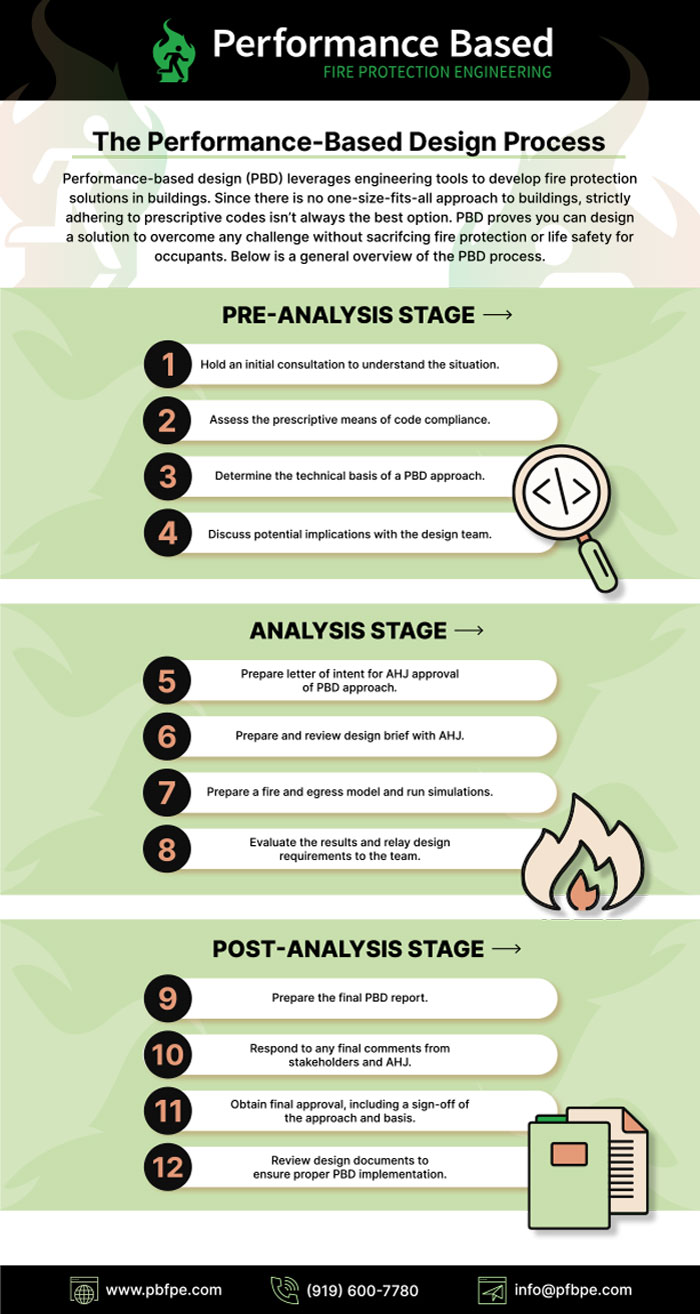 Download Infographic
Performance-based design is particularly valuable in:
Even in these cases, performance-based design typically addresses only a few specific fire safety objectives rather than redefining the entire project.
For projects that push the boundaries of traditional design, performance-based design offers the flexibility to engineer custom life safety solutions without being boxed in by prescriptive requirements.
Performance-based design empowers engineers to create solutions that cater to the unique needs of a building, its occupants, and its intended function. It’s beneficial for cutting-edge technologies, assembly occupancies, or unconventional buildings that fall outside the scope of standard codes.
Instead of applying one-size-fits-all requirements, performance-based design focuses on what’s necessary to achieve safe outcomes. For example, an egress analysis might show that an increased travel distance is acceptable, increasing the usable area and maximizing the building potential without compromising safety.
However, with greater design power comes greater responsibility. Performance-based approaches demand advanced analysis, detailed documentation, and often a higher level of scrutiny from code officials.
Developing a performance-based solution takes time, expertise, and specialized hardware and software. Fire and smoke modeling and human behavior analysis can be resource-intensive, especially for larger or higher-risk projects.
Because performance-based designs deviate from prescriptive code, they often face more rigorous review by AHJs and sometimes even third parties. Success depends on clear documentation, peer-reviewed methodologies, and early engagement with code officials to build trust and transparency.
Not every fire protection engineer has the training, experience, and resources to perform advanced fire modeling. Therefore, you should engage qualified professionals who specialize in performance-based fire engineering.
The reality is that nearly every project follows prescriptive code for the majority of its fire protection design. Performance-based methods are used selectively to solve problems that can’t be addressed prescriptively.
If your project is somewhat standard (think typical building type and use), prescriptive codes are usually the easiest and most reliable way to go. They lay out clear requirements, which makes design and permitting simpler and more predictable. This means less time spent on engineering studies or back-and-forth with regulators.
But if your project has complex architectural features, limiting existing conditions, unique uses, or you’re expanding into emerging technologies, prescriptive codes might not cut it. Keep in mind, though, that performance-based design usually takes more time, expertise, and documentation to satisfy regulators. You’ll want to be ready to invest in these resources and maintain open communication with code officials to get approvals smoothly.
The best advice? Bring a licensed fire protection engineer on board early. They’ll help you understand your project’s unique challenges and figure out the right code strategy, saving you from costly redesigns and approval headaches down the line, while keeping safety and efficiency front and center.
Prescriptive codes form the foundation of nearly every fire protection design. They provide the consistency, clarity, and reliability needed for most projects. Performance-based design, on the other hand, acts as a precision tool that’s used sparingly and strategically to resolve specific challenges that fall outside prescriptive boundaries.
By engaging a licensed fire protection engineer early, you can identify potential compliance issues before they become costly and determine where performance-based design may be beneficial.
When you need help understanding prescriptive code or implementing a performance-based approach, count on the licensed fire protection engineers at Summit Fire Consulting to deliver optimal results. Contact us to start the conversation.
